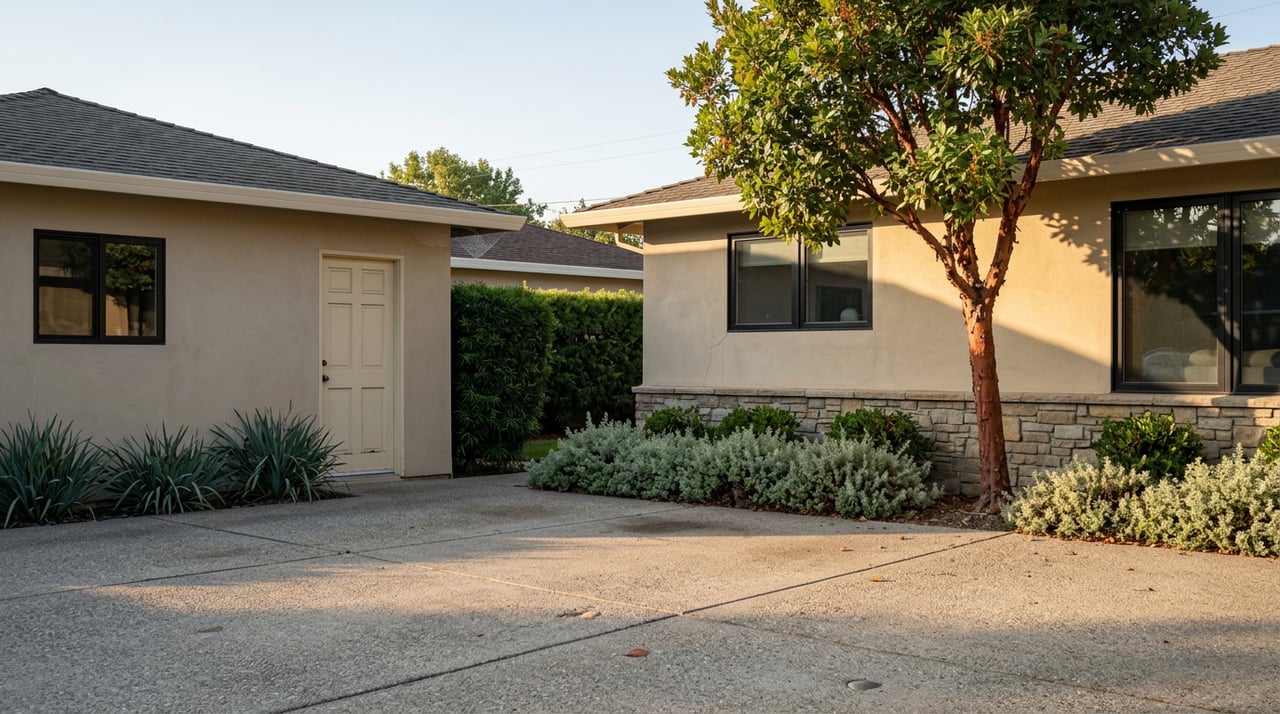
Walk down almost any street of 1950s and 60s ranch homes in Sherman Oaks and you will eventually pass a garage door that has not opened in years. Paint peels at the seam where the track used to slide. Behind it, if you ask the seller directly, is usually a bedroom, a home office, or a small studio with its own bathroom, built at some point without a permit because a permit meant paperwork, inspections, and a wait. For decades, the safest advice an agent could give a seller in this position was simple: disclose it, price around it, and let the discount do the work.
That advice just got more expensive to follow than the alternative it was designed to avoid.
The math that used to make sense
Legalizing an unpermitted room addition or garage conversion in Los Angeles has historically meant bringing the entire space up to the building code in effect the day you applied, not the code in effect when the work was actually done. For a garage converted into living space in 1987, that could mean new electrical, new insulation to meet current energy standards, updated egress windows, and a full plan check, on top of whatever impact fees and utility connection charges the city assessed along the way. For a lot of Sherman Oaks sellers, the repair bill for full compliance ran higher than the value the square footage would add at resale. So the rational move was to skip it, disclose the condition on paper, and let the buyer negotiate a credit.
That is still a legitimate path today. It is just no longer the obviously cheaper one.
What the state actually changed, and when
Assembly Bill 2533 took effect statewide, and it built on an earlier legalization pathway for unpermitted units by adding coverage for unpermitted ADUs and JADUs built between 2018 and 2020. The core idea is that a local agency generally cannot deny a permit for a qualifying pre-2020 unpermitted unit because it fails to meet current building standards or the local ADU ordinance. The only real exception is health and safety, evaluated under Health and Safety Code Section 17920.3.
Los Angeles caught up to that framework this summer. On July 15, 2026, the Los Angeles Department of Building and Safety replaced its longstanding ADU bulletin, Information Bulletin P/BC 2023-150, with an updated version, P/BC 2026-150, that folds in AB 2533 and the 2025 building and residential code references. Streamlined AB 2533 projects now run through a separate bulletin, P/BC 2026-161. Together they spell out something concrete for anyone sitting on an unpermitted garage conversion in Sherman Oaks:
- If the unit was built before January 1, 2020, LADBS reviews it against health and safety standards, not full current code.
- New work still has to meet Title 24 energy requirements, but the existing pre-2020 structure itself does not, as long as it is going through the AB 2533 path.
- The same exemption applies to the Los Angeles Green Building Code for the existing construction.
- Impact fees, connection charges, and capacity charges are waived for qualifying pre-2020 units unless utility upgrades are needed for health and safety, and the units are exempt from Park Fees and the Affordable Housing Linkage Fee. LAUSD school fees still apply once an ADU exceeds 500 square feet.
- Review is ministerial. LADBS has 60 days to approve or deny a complete application, and under SB 543 it now has to confirm your application is complete within 15 business days.
None of this erases every cost. A converted garage still needs a habitable floor, working plumbing if it has any, and safe egress. But the gap between "bring this up to code" and "make this safe" is a lot narrower than it was two years ago, and the fee waivers remove a cost that used to catch sellers off guard late in the process.
Before and after, in plain terms
| Before AB 2533 / pre-July 2026 | Under the current LADBS bulletin | |
|---|---|---|
| Code standard for pre-2020 units | Full current building code | Health and safety standard only |
| Energy compliance for existing structure | Required | Exempt for pre-2020 units under AB 2533 |
| Impact and connection fees | Charged in full | Waived unless health and safety infrastructure is needed |
| Typical seller response | Disclose and discount | Legalize, disclose, or discount, genuinely comparable options |
That last row is the point. A Sherman Oaks property with a legal ADU in place sits on the right side of a documented value gap. A 2024 UC Irvine study of Los Angeles parcels found that ADU presence was associated with roughly a 7 to 9 percent increase in assessed value and selling price. Meanwhile, the discount buyers price in for an unpermitted ADU has been narrowing, generally landing in a 5 to 12 percent range rather than the steeper hit a converted garage without any bathroom upgrade might still take, which tends to run 8 to 15 percent. Run those two ranges against each other for a mid-market Sherman Oaks home and the fee-waived legalization path starts looking like the better trade more often than it used to.
The disclosure obligation does not disappear either way
Here is where sellers sometimes talk themselves into a false sense of security. Selling "as-is" does not remove the duty to disclose. California Civil Code Section 1102 requires sellers of one to four unit residential properties to complete a Transfer Disclosure Statement, and that form specifically asks about additions, alterations, or repairs made without required permits. Checking "no" when you know otherwise is not a shortcut. It is concealment, and California courts have held for decades, going back to the 1963 case Lingsch v. Savage, that a seller who knows facts materially affecting a property's value has a duty to disclose them even if the buyer has the right to inspect. Civil Code Section 1710 covers fraud by concealment, and that exposure follows the seller well past closing.
The practical upshot is that the choice was never really "disclose or don't." It was always "disclose and discount" versus "legalize and avoid the discount." AB 2533 just changed how far apart those two paths sit financially, and for a lot of Sherman Oaks properties, it changed which one comes out ahead.
What this means if you are listing before the end of the year
Sherman Oaks has a specific advantage worth knowing about if a garage conversion is on the table. Many lots here fall within the half mile transit exemption under Government Code Section 66322, which means no replacement parking is required when a garage or covered space is converted, a rule that matters in a neighborhood built around the 405 and 101 corridor where off-street parking is otherwise assumed. That lowers one of the more common cost objections to legalizing a garage conversion right out of the gate.
Financing is the other half of the equation. Fannie Mae and Freddie Mac underwriting guidance treats legal ADUs differently from unpermitted units, and FHA and VA appraisers routinely exclude unpermitted square footage from the appraised value or require a lender sign-off before closing. A legalized unit widens the pool of buyers who can actually finance the purchase, not just the cash buyers who can absorb the risk.
If you are weighing this decision, the first real step is documentation, not construction. Confirm the actual construction date of the unpermitted space, since the January 1, 2020 line determines whether AB 2533's lighter review applies at all. From there, an as-built plan and a straightforward conversation with a licensed contractor familiar with LADBS's current process, the kind of work firms like Kyra Construction handle regularly in this neighborhood, will tell you whether the safety-only path closes the gap before your listing photos go live.
FAQ
Does the amnesty program cover an ADU or conversion built after 2020? No. AB 2533 and the current LADBS bulletin apply to units built before January 1, 2020. Anything built after that date is expected to meet the building code and ADU standards in place at the time of construction, with no safety-only shortcut.
If I sell as-is, do I still have to disclose the unpermitted work? Yes. The Transfer Disclosure Statement requirement under Civil Code Section 1102 applies regardless of as-is language in the purchase contract. As-is affects repair obligations, not disclosure obligations.
Will applying for a permit under AB 2533 delay my closing timeline? It depends on how far along the file is before you list. LADBS has 60 days to act on a complete application and must confirm completeness within 15 business days under SB 543. Starting the process before you list gives you a real answer before you are under contract, rather than during escrow.
Does any of this matter if my buyer plans to pay cash? Cash buyers avoid the lender restrictions that come with unpermitted space, but a documented, legal ADU still protects their own resale position down the road, and it is one less thing for their own inspection contingency to snag on.
If you are weighing whether to legalize, disclose, or simply price around an unpermitted space in your Sherman Oaks home, Lynna Hall can walk through the actual numbers for your property before you list. Let's Connect.