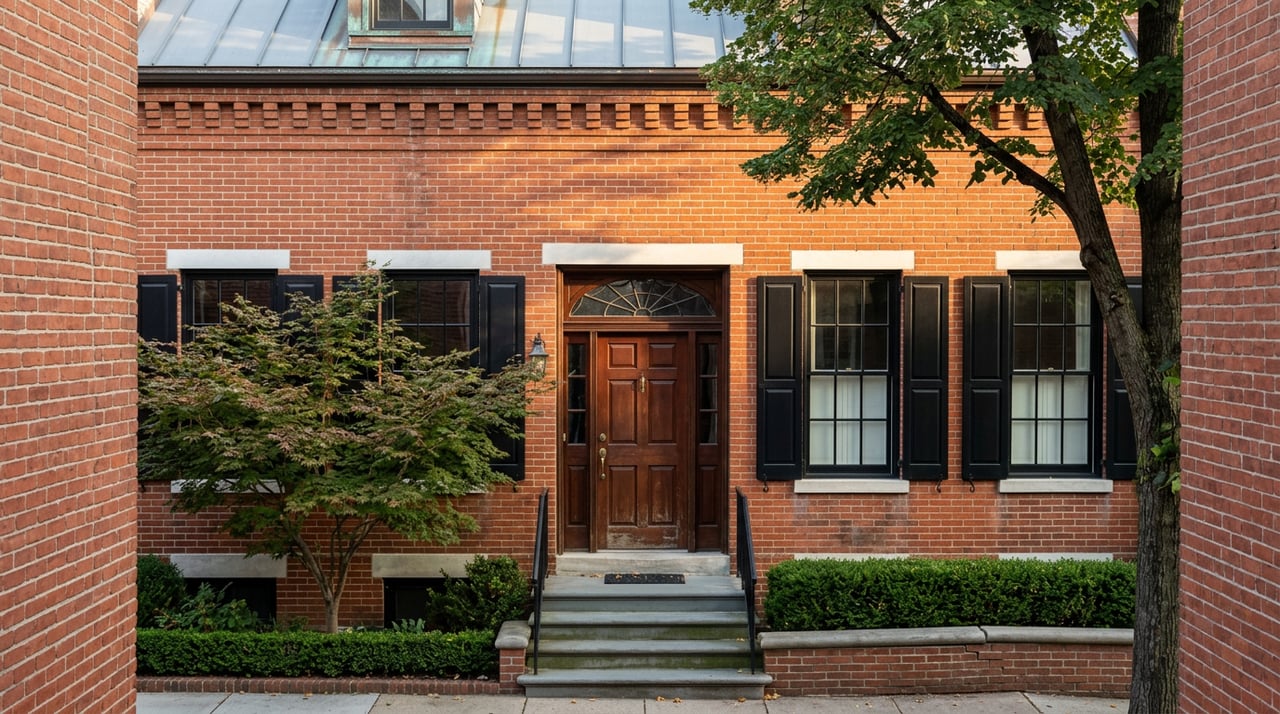
You found the house. A brick colonial on a wooded acre in Franklin Park, the kind of lot that doesn't come up twice a year. You are ready to write an offer this weekend, because over the three months ending in May 2026, McLean homes were going under contract in a median of 19 days, and you have already watched two other listings disappear while you waited on an inspection report.
Then your lender's underwriter sends a list. A coliform bacteria test on the well, required as a condition of financing. A copy of the septic drainfield plat, which the seller does not have on file. Proof that the tank has been pumped in the last five years, a Fairfax County requirement your title company flags automatically. None of this shows up on a comparable sewer-connected listing three streets over, where the same lender closes in three weeks flat. Here, you are waiting on a soil scientist's schedule.
This is the moment most buyers first learn that a meaningful slice of McLean's older, large-lot neighborhoods, the kind of streets you find in Franklin Park, Chesterbrook, Ballantrae, Evans Mill, Salona Village, and parts of The Langley, still run on private wells and septic systems rather than the county water and sewer lines that serve most of Fairfax. And it is the moment most buyers reach for a comforting assumption: surely, in one of the wealthiest zip codes in Virginia, the pipe is close and connection is just a matter of time and paperwork.
That assumption is the thing worth correcting before you write the offer.
Why These Pockets Never Got the Pipe
Most of McLean's well-and-septic homes were built in the 1960s through the 1980s, on lots large enough to support a private system when the county's sewer network hadn't yet reached that far out. Fairfax County's sewer service area was formally defined by a 1979 Board of Supervisors policy, and it drew its boundary around where gravity lines could reasonably reach, not around every acre inside county limits. Homes built just outside that boundary, or on lots too far from a main to connect economically, stayed on wells and septic fields by default. Many never had a reason to change, since a well-maintained system on a large lot can function for decades.
The county still counts roughly 24,000 homes on septic systems, and it requires every one of them to have the tank pumped at least once every five years under the county code. That requirement exists for public health reasons, but it also becomes a document buyers should ask for the moment they tour a property like this. If the seller cannot produce a recent pump-out record, budget time for the county's Onsite Sewage and Water Program to help track one down, and expect the process to run on the county's calendar, not your closing date.
What the Contract Actually Looks Like
The friction is not hypothetical. It shows up in three specific places during a transaction, and it is worth knowing before you are already under contract with a clock running.
| Step | Sewer-connected home | Well and septic home |
|---|---|---|
| Financing condition | Standard appraisal and inspection | Lender typically requires a coliform bacteria test on the well as a condition of the loan |
| Inspection scope | Plumbing inspection covers fixtures and lines | Add a septic inspection, drainfield plat request, and pump-out history review |
| Timeline risk | Weeks | Add lead time for soil scientist or county records requests, which do not move on a real estate closing schedule |
None of this makes a well-and-septic property a worse purchase. It makes it a different one, with a due diligence checklist that a fast market does not always leave room for. Buyers who know this going in can build the extra week into their offer terms. Buyers who don't find out when the underwriter's list arrives.
The County's Own $122 Million Answer
Here is where the assumption that "sewer must be close by now" runs into the county's actual spending priorities.
Fairfax County has been advancing the Tysons East Pump Station, a $122 million project designed to add sanitary sewer capacity for the growth already reshaping eastern Tysons. The project needs land, and the county's preferred site is a residential parcel at 1310 Scotts Run Road in McLean. In the fall of 2024, the Board of Supervisors authorized a public hearing to consider using eminent domain to acquire that property, after a planned outreach process to neighbors fell short and the hearing had to be postponed. The pump station is designed to process 10 million gallons of wastewater per day and sits inside a broader $388.6 million countywide initiative to expand gravity sewer capacity through fiscal year 2034.
That is a serious amount of public money moving through McLean's sewer system right now. It is not, however, aimed at the septic pockets a few blocks away. It is aimed at Tysons East, where office and mixed-use redevelopment is driving demand for capacity the existing pipes cannot handle. The county is willing to negotiate, and if necessary condemn, private property to build infrastructure for that growth corridor. It has made no comparable commitment to extend service to legacy septic lots in Franklin Park or Chesterbrook, because those lots are not driving the capacity math that justified the pump station in the first place.
Meanwhile, a separate and unrelated infrastructure effort has been playing out closer to those neighborhoods. The Tucker Avenue Neighborhood Stormwater Improvement Project, covering roughly 67 acres across the Chesterfield, Chesterbrook Gardens, and Grass Ridge communities, broke ground in April 2024 with an original target of April 2026. That date came and went. As of this summer, the county's Department of Public Works and Environmental Services said the project had reached its final stages, with completion now expected this fall. Residents there have dealt with a collapsed section of Barbee Street, exposed utility caps, and gas line breaks during the work, a reminder that underground infrastructure in these older neighborhoods gets touched, disrupted, and eventually rebuilt on the county's timeline, not the homeowner's.
Put together, these two stories tell you something specific: the county is capable of moving fast and spending big on sewer infrastructure when a growth corridor demands it. Legacy residential septic areas get maintenance and stormwater work, not new sewer mains, unless a specific redevelopment case makes the extension worth the cost.
What "Sewer Is Nearby" Actually Means in the Code
If you are looking at a septic property and can see a sewer main on the street one block over, it is worth understanding exactly what has to be true before that main becomes relevant to your lot.
Under Fairfax County's code, a sanitary sewer main is only considered "available" to a single-family home if it runs within 300 feet of the building. If your lot falls outside that distance, the property is not eligible to connect without an extension, and the code is explicit that the cost of extending the line falls on the property owner requesting the connection, not the county. Extensions across the approved sewer service area boundary are also capped at 400 feet, so a lot that sits just beyond that limit may not have a legal path to connection at all, regardless of what a neighbor down the street has.
This is the detail that separates "sewer is basically right there" from "sewer is available to this parcel." Before assuming a septic home is one permit away from a county hookup, it is worth a call to the county's Wastewater Planning and Monitoring Division to confirm distance and service area status for that specific address.
The Real Cost If You Want to Connect
For buyers who decide connection is worth pursuing, current national cost guides put septic-to-sewer conversion at roughly $5,000 to $15,000, covering decommissioning the old system and running a new line to the main. On top of that, municipalities charge a one-time tap fee to connect to the public sewer, which can run anywhere from a few hundred dollars in smaller systems to $10,000 or more in areas where infrastructure was recently built and the utility is recovering construction costs from new connections.
That is a real number to weigh against the alternative: a well-maintained septic system on a large lot can run reliably for years with routine pumping and a modest annual maintenance cost, often close to what a comparable sewer bill would run. For many buyers, the smarter move is not conversion at all, but a clear-eyed inspection, a full set of pump-out records, and a purchase price that reflects the system exactly as it stands.
A Few Questions Worth Asking Before You Tour
Does a well-and-septic system affect resale value in McLean? Not inherently. Buyers in this price range are usually comparing lot size, privacy, and condition first. A well-documented, recently serviced system rarely becomes a sticking point. An undocumented one, with no pump-out records, can slow a transaction down at exactly the wrong moment.
How do I find out if a specific McLean address is on septic? Ask your agent to pull the property's utility status before you tour, or contact Fairfax County's Onsite Sewage and Water Program directly. Listing descriptions do not always mention it.
Is county sewer coming to these neighborhoods eventually? Based on where the county's current sewer capital spending is going, the honest answer is that expansion is following growth corridors like Tysons East, not legacy residential streets. Absent a specific extension petition and a property within 300 feet of an existing main, there is no active plan to change that.
If you are looking at a home in McLean's well-and-septic pockets, or preparing to sell one, the difference between a smooth closing and a stressful one usually comes down to what you know before you are under contract. Lynna Hall works with buyers and sellers across McLean's full range of housing stock, from Silver Line-adjacent condos to the large, wooded lots where the pipe never came. Let's Connect before you write the offer, not after the underwriter's list arrives.